

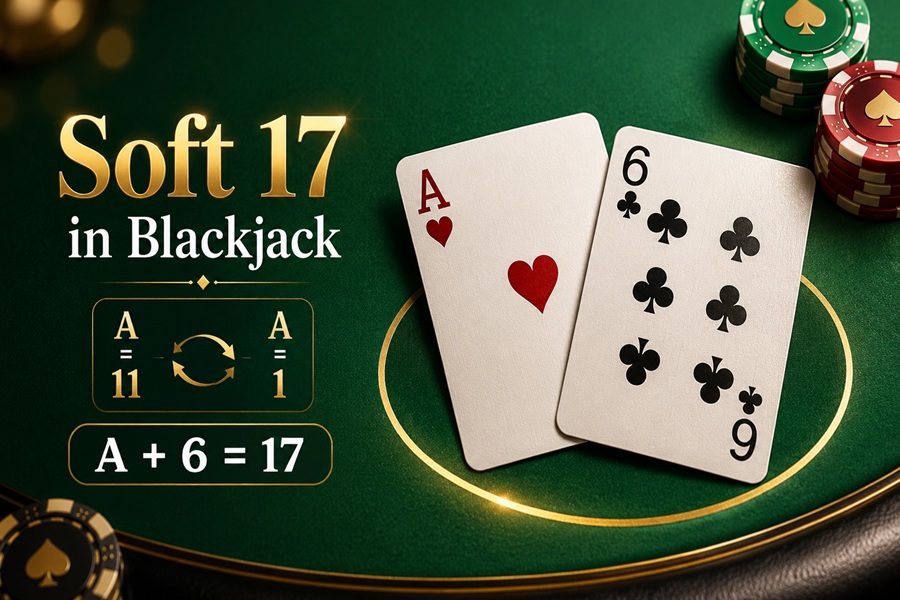
A soft 17 is any blackjack hand that totals 17 and contains an ace counted as 11. The classic example is Ace-6. Because the ace can drop to 1, you can take another card without any risk of busting. That flexibility is the whole point, and it also drives one of the most important rules at the table.
Let us break it down cleanly: what a soft 17 is, how it differs from a hard 17, why the dealer’s rule about it matters, and how you should actually play it.
What does “soft” mean in blackjack?
A hand is soft when it holds an ace that can count as 11 without busting. The ace gives the hand two totals at once.
That second value is a safety net. Draw a big card, and the ace simply slides from 11 down to 1. Your hand cannot bust on the next card.
A hand is hard when it has no ace, or when the ace must count as 1 because counting it as 11 would push you over 21.
Quick contrast:
- Soft hand: Ace-6 (totals 7 or 17). Flexible.
- Hard hand: 10-7 (totals 17, fixed). No flexibility.
The ace is the only card that can create a soft hand. No other card carries two values.
So what exactly is a soft 17?
A soft 17 is a soft hand that adds up to 17 with the ace valued at 11. Take another card and you cannot bust, because the ace can always fall back to 1.
The key detail: the total is not locked. It can move up or down depending on what you draw next. That is what separates it from a hard 17, which is stuck.
What card combinations make a soft 17?
More than you might think. Any mix that lands on 17 with an ace still counting as 11 qualifies.
| Combination | How it totals 17 |
|---|---|
| Ace + 6 | 11 + 6 |
| Ace + 2 + 4 | 11 + 2 + 4 |
| Ace + 3 + 3 | 11 + 3 + 3 |
| Ace + 4 + 2 | 11 + 4 + 2 |
| Ace + 5 + Ace | 11 + 5 + 1 (second ace as 1) |
The exact cards do not matter. As long as one ace still counts as 11 and the total sits at 17, it is a soft 17.
Soft 17 vs hard 17: what is the difference?
This is where a lot of players get tripped up. Both total 17. They play nothing alike.
| Feature | Soft 17 (e.g. Ace-6) | Hard 17 (e.g. 10-7) |
|---|---|---|
| Contains a flexible ace | Yes | No |
| Can it bust on a hit | No | Yes |
| Total is locked | No | Yes |
| Correct player move | Hit or double | Always stand |
Here is the takeaway most beginners miss: you never stand on a soft 17, but you always stand on a hard 17. Same number, opposite play. The ace is the reason.
Why should you hit or double a soft 17?
Because 17 is a weak winning hand, and a soft 17 lets you improve it for free.
A hard 17 rarely wins outright. The dealer beats it whenever they land 18 through 21. Standing on 17 mostly hopes the dealer busts.
With a soft 17, you get a second chance the hard 17 does not have. You can draw a card, and:
- If you improve to 18, 19, 20, or 21, you stand on a much stronger hand.
- If you draw a small card, you still hold a playable total.
- If you draw a big card, the ace drops to 1 and you simply keep going.
There is no downside to taking that card. Against a weak dealer upcard like a 5 or 6, the smart move is often to double down and put more money on a hand that cannot bust on the next draw.
What is the soft 17 rule for the dealer?
Here is where soft 17 stops being just a hand and becomes one of the most important rules in the game.
The soft 17 rule tells the dealer what to do when their own hand totals soft 17. There are two versions, and every table uses one or the other:
- S17 (Stand on soft 17): The dealer must stop. Better for you.
- H17 (Hit on soft 17): The dealer must take another card. Better for the house.
You will see this printed right on the felt. It usually reads “Dealer stands on all 17s” or “Dealer hits soft 17.”
Does the soft 17 rule change the house edge?
Yes, and it moves in the casino’s favor when the dealer hits.
When the dealer hits soft 17, they bust a little more often, which sounds good for you. But when they do not bust, they frequently turn that 17 into an 18, 19, 20, or 21, which beats hands that would have pushed or won against a standing 17.
The net effect: H17 adds roughly 0.20% to the house edge compared to S17. That sounds tiny. Over hundreds of hands, it is real money leaving your bankroll.
Rule of thumb: given a choice, pick the S17 table. It is one of the cleanest ways to shave the house edge without any extra skill.
How does soft 17 change your basic strategy?
Only slightly, and only on a handful of hands. The dealer’s soft 17 rule tweaks a few borderline decisions.
General guidance for a standard multi-deck game:
- Soft 13 to soft 17: Hit, or double against weak dealer upcards (roughly 4, 5, 6).
- Soft 18 (Ace-7): Stand against 2, 7, 8. Double against 3 through 6. Hit against 9, 10, ace.
- Soft 19 and up: Almost always stand.
Under H17 rules, a few plays get slightly more aggressive, such as doubling soft 18 and 19 in specific spots and adjusting a couple of surrender decisions. The core idea never changes: soft hands want action, not caution.
What do players say about soft 17 in forums?
Community wisdom lines up neatly with the math here.
On blackjack subreddits and the Wizard of Odds forum, the most repeated beginner mistake players call out is standing on soft 17 because “17 is a stand.” Experienced players push back hard: a soft 17 is not a real 17, it is a launchpad. Quora answers echo the same point, describing Ace-6 as a hand you should never freeze on, because the ace removes all the bust risk.
The other recurring tip from regulars: check the felt for “hits soft 17” before you sit. Grinders treat H17 vs S17 as a table-selection filter, not an afterthought, because that 0.20% compounds across a session.
Frequently asked questions
Is Ace-6 always a soft 17?
Yes. Ace counted as 11 plus 6 equals 17, and the ace can still drop to 1, so it is soft. It is the most common soft 17 you will see.
Should I ever stand on a soft 17?
As a player, no. You hit or double a soft 17. You only ever stand on a hard 17.
What does “dealer hits soft 17” mean for me?
It means the dealer takes another card on soft 17 instead of stopping. That rule raises the house edge by about 0.20%, so prefer tables where the dealer stands.
Can a soft 17 turn into a hard 17?
Yes. If you hit a soft 17 and draw a card that forces the ace to count as 1, the hand becomes hard. At that point you play it like a fixed total.
Is soft 17 better than hard 17?
For a player, yes, because you can improve it risk-free. A hard 17 is stuck. A soft 17 has room to grow.
Why does the ace make a hand soft?
Because the ace is the only card worth either 1 or 11. That dual value gives the hand two totals and removes bust risk on the next card.