

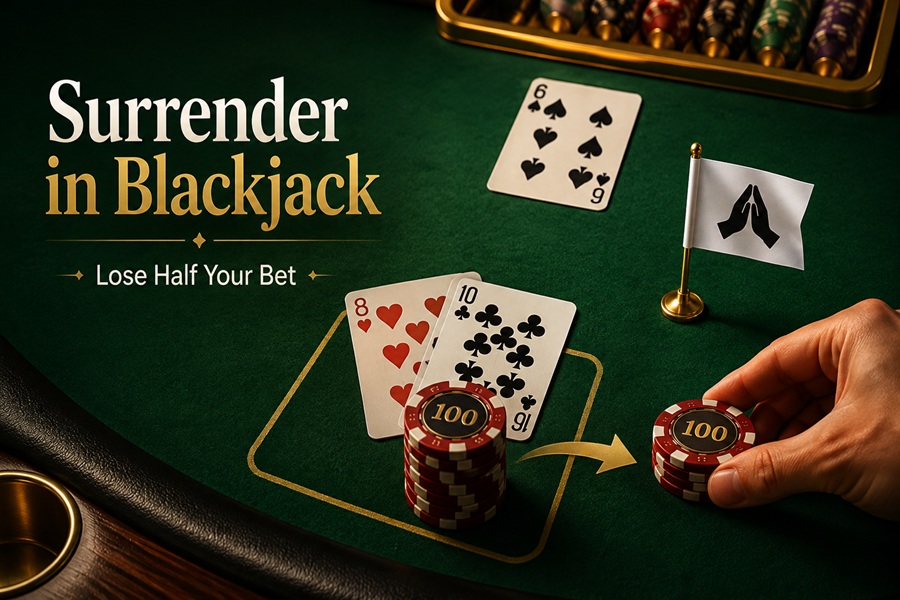
Surrender is a blackjack option that lets you fold a bad hand and keep half your bet instead of risking all of it. You give up the hand, hand back half your wager, and sit out the rest of the round. Used at the right moment, it is not weakness. It is one of the sharpest defensive plays in the game. Used at the wrong moment, it just burns money. This guide shows you the difference.
What does it mean to surrender in blackjack?
When you surrender, you tell the dealer you are done with the hand before playing it out. In return:
- You lose half your original bet.
- Your other half comes back to you.
- Your cards are removed and you wait for the next round.
Think of it as damage control. Some hands are so likely to lose that giving up half beats fighting for the whole thing. Surrender is the tool that lets you cut that loss.
One firm rule: surrender must be your first move. You can only do it on your opening two cards, before you hit, stand, double, or split. Take any other action first and surrender is gone for that hand.
How do you signal a surrender?
At a live table, you say “surrender” and often draw an imaginary horizontal line behind your bet with your finger. Online, you simply click the Surrender button. Either way, the dealer takes your cards, returns half your chips, and moves on.
Not every table offers it. Surrender is common in some blackjack variants and absent in others. Always check the rules or ask the dealer before you count on it.
What is the difference between early and late surrender?
There are two kinds, and the gap between them is bigger than it looks. It comes down to timing around the dealer’s blackjack check.
| Feature | Early surrender | Late surrender |
|---|---|---|
| When you can surrender | Before the dealer checks for blackjack | After the dealer checks for blackjack |
| Protection vs dealer blackjack | Yes, you escape even if dealer has 21 | No, you lose the full bet if dealer has 21 |
| How common | Rare | Common |
| Value to the player | Higher | Lower but still useful |
Early surrender lets you fold before the dealer peeks for a natural. If the dealer shows an ace or a 10, you can bail out immediately, even if they end up holding blackjack. That protection is valuable, which is exactly why casinos rarely offer it.
Late surrender is the version you will actually find. You can only surrender after the dealer checks their hole card and confirms they do not have blackjack. If they do have it, you lose your whole bet and never get the option.
When a page just says “surrender” with no label, it almost always means late surrender.
When should you surrender in blackjack?
This is the part most guides skip, and it is the whole value of the article. Surrender is correct only in a small set of specific spots. Outside them, it costs you money.
The logic is simple. Surrendering locks in a loss of exactly half your bet, or 0.50 units. Surrender is the right play only when your best alternative (hitting or standing) would lose more than half your bet on average.
For a standard game using four or more decks, here are the hands to surrender.
Late surrender chart (dealer stands on soft 17)
| Your hand | Dealer upcard | Play |
|---|---|---|
| Hard 16 (not 8-8) | 9 | Surrender |
| Hard 16 (not 8-8) | 10 | Surrender |
| Hard 16 (not 8-8) | Ace | Surrender |
| Hard 15 | 10 | Surrender |
That is the core chart. Memorize those four spots and you have captured almost all the value surrender offers.
Extra surrenders when the dealer hits soft 17 (H17)
If the table has the dealer hit soft 17, add these:
| Your hand | Dealer upcard | Play |
|---|---|---|
| Hard 15 | Ace | Surrender |
| Hard 17 | Ace | Surrender |
| Pair of 8s | Ace | Surrender |
Yes, surrendering a hard 17 against an ace looks strange. Under H17 rules, the math genuinely favors it, because the dealer’s ace is that dangerous.
Why is surrendering half a bet the smart play?
Because losing less is still winning at the margins. Run the numbers on the classic spot.
Take hard 16 against a dealer 10:
- If you hit or stand, you lose roughly 54% of your bet on average over the long run.
- If you surrender, you lose exactly 50% of your bet.
Surrender saves you about 4 cents on every dollar wagered on that hand. It feels small. It is. But across a session and across many sessions, those saved cents add up, and they cost you nothing to collect.
A hand has to be a genuine loser to justify surrender. In fact it needs to lose clearly more than 75% of the time (winning 25% and losing 75% averages out to a half-bet loss). That is why the list of surrender hands is so short.
The mistake almost everyone makes
Here is where casual players bleed money, and it goes in two directions.
Mistake one: surrendering too much. Players see any 16 and panic. But 16 against a dealer 7 or 8 is not bad enough to surrender. Hit it. And 16 against 2 through 6 should stand. Only 16 against 9, 10, or ace is a surrender.
Mistake two: surrendering a pair of 8s. A pair of 8s totals 16, so it looks like a surrender candidate. It is not. Always split 8s instead. Splitting turns one terrible 16 into two hands that each start with 8, and the math on splitting beats the half-bet loss from surrender. The only exception is 8-8 against an ace in an H17 game, where surrender can edge ahead.
Mistake three: trying to surrender after hitting. You cannot. Surrender is a first-move-only option. If you already took a card, the button should not even appear.
Does surrender lower the house edge?
Yes, slightly. Used correctly, late surrender trims the house edge by roughly 0.07% to 0.10%. That is a small gift, but it is a gift, and it is free.
The catch: the benefit only exists if you surrender the right hands and only the right hands. Surrender the wrong hands and you hand that edge straight back, and then some. The rule is a scalpel, not a hammer.
What do experienced players say about surrender?
Forum regulars have a clear consensus, and it pushes against a common instinct.
On blackjack subreddits and strategy forums like Wizard of Odds and Blackjack Apprenticeship, the repeated message is that surrender is underused, not overused, by knowledgeable players, and overused by beginners who panic. Skilled players describe it as routine, not shameful. When surrender is the highest-value play, using it is simply correct.
The other recurring point in threads: never confuse “16 is a bad hand” with “surrender every 16.” Regulars stress that only three 16 spots (versus 9, 10, and ace) plus 15 versus 10 make the standard chart. Everything else is a normal hit, stand, or split.
Unique insight: surrender is a bankroll tool, not a comeback tool
Most guides frame surrender as a way to escape a bad hand. Reframe it as a way to protect your session, and you will use it correctly.
Surrender never wins you anything. It cannot. It only ever reduces a loss. That means its real job is not on any single hand. Its job is to slow the rate at which your bankroll drains across an entire session, so you stay in the game longer with more chips.
Players who chase the “escape” feeling surrender too often and lose the edge. Players who treat it as quiet bankroll defense, used on four hands and ignored on the rest, capture the full value. Surrender is boring when done right. Boring is the point.
Frequently asked questions
How much do you lose when you surrender in blackjack?
Exactly half your original bet. The other half is returned to you, and you sit out the rest of the round.
When should you surrender in blackjack?
Surrender hard 16 against a dealer 9, 10, or ace, and hard 15 against a dealer 10. Under H17 rules, also surrender 15 vs ace, 17 vs ace, and 8-8 vs ace.
What is the difference between early and late surrender?
Early surrender happens before the dealer checks for blackjack, so it protects you even against a dealer 21. Late surrender happens after that check and is the version most casinos offer.
Should you surrender a pair of 8s?
No. Always split 8s instead, in almost every game. The only exception is 8-8 against a dealer ace when the dealer hits soft 17.
Can you surrender after hitting?
No. Surrender must be your first action on your opening two cards. Once you hit, stand, double, or split, the option is gone.
Does every blackjack table offer surrender?
No. Surrender is available on some games and variants but not all. Check the felt, the game rules, or ask the dealer before relying on it.