

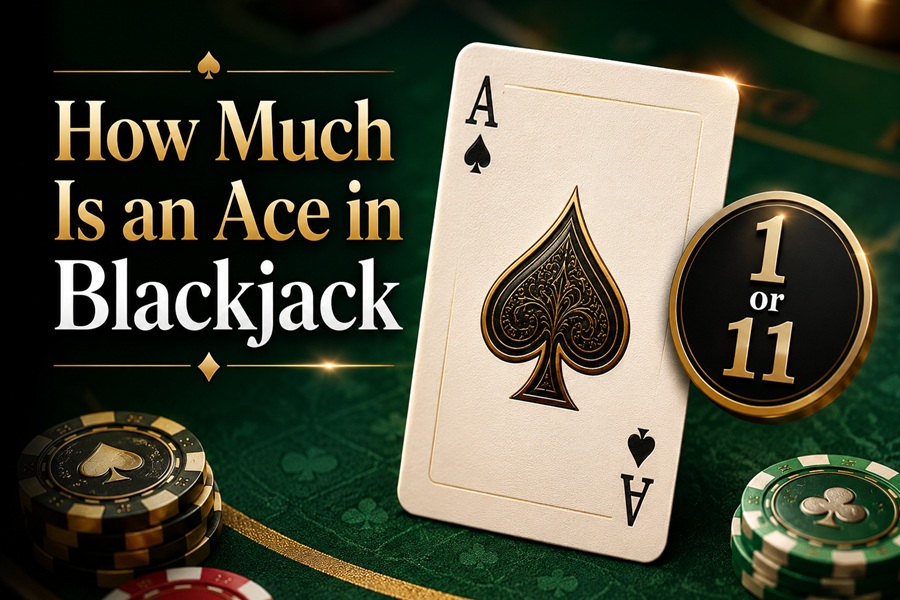
An ace in blackjack is worth either 1 or 11, whichever value helps your hand more. It is the only card in the deck with two values, and that flexibility makes it the most powerful card you can hold. This guide walks you through exactly how the ace works, when it counts as 11, when it drops to 1, and how to play it like someone who knows what they are doing.
What are the card values in blackjack?
Before the ace, get the basics down. Every card has a fixed value except one.
| Card | Value |
|---|---|
| 2 through 9 | Face value (a 7 is worth 7) |
| 10 | 10 |
| Jack, Queen, King | 10 each |
| Ace | 1 or 11 |
Suit never matters. A jack of spades and a jack of hearts are both worth 10. Only the ace breaks the one-value rule, and that is what makes it special.
How much is an ace worth in blackjack?
The ace is worth 11 by default, unless counting it as 11 would bust your hand. In that case it automatically becomes 1.
You do not have to announce the choice. The value bends to whatever keeps you alive and gives you the strongest total. Think of the ace less as a fixed number and more as a slider that moves between 1 and 11 as your hand changes.
Here is the simple logic the game follows:
- Counting the ace as 11 keeps you at 21 or below? It stays 11.
- Counting the ace as 11 would push you over 21? It drops to 1.
That single mechanic is the reason the ace sits at the heart of nearly every strong hand in the game.
Let us walk through one hand, card by card
The best way to understand the ace is to watch one live. Follow along.
You are dealt: Ace + 3.
Your total is 4 or 14. The ace is counting as 11, so you sit on a soft 14. Nice and flexible. No card can bust you.
You hit and draw a 3.
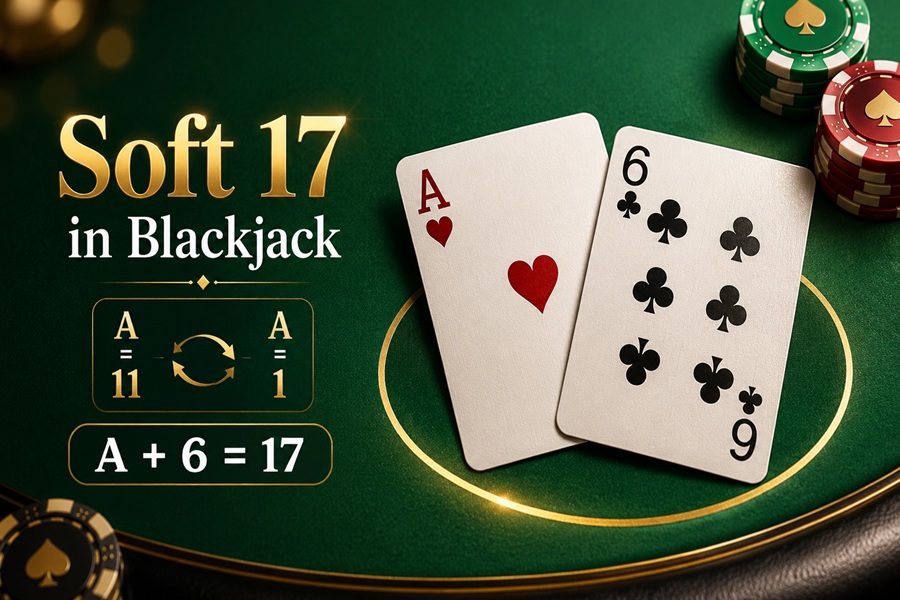
Now you hold Ace + 3 + 3. Your total is 7 or 17. The ace is still 11, so you have a soft 17. Still no bust risk. Still room to improve.
You hit again and draw a 10.
Now you hold Ace + 3 + 3 + 10. If the ace stayed at 11, you would total 27 and bust. So the ace slides down to 1. Your hand becomes a hard 17 (1 + 3 + 3 + 10).
Notice what happened. The ace protected you the entire way up, then quietly became a 1 exactly when you needed it to. That is the ace doing its job.
What is a soft hand, and why does the ace create it?
A soft hand is any hand with an ace counted as 11. It is called soft because it cannot bust on the next card. The ace can always fall back to 1.
Examples:
- Ace-7 is a soft 18 (also playable as 8).
- Ace-4 is a soft 15 (also playable as 5).
- Ace-2-4 is a soft 17 (also playable as 7).
Soft hands are safer to hit because there is no immediate bust risk. That freedom is why the ace is so valuable. It hands you a second, lower total to fall back on whenever the top total gets dangerous.
A hard hand either has no ace, or has an ace forced to count as 1. Hard hands are riskier. Every hit can push you over 21.
Why is the ace the most valuable card in blackjack?
Two words: natural blackjack.
An ace paired with any 10-value card (10, jack, queen, or king) makes a natural blackjack, a two-card 21. It is the best possible starting hand, and it usually pays 3:2. Bet 10 and you collect 15.
Beyond the natural, the ace powers the game in three ways:
- It builds the strongest hand instantly. No other card can make a two-card 21.
- It removes bust risk. Any hand with a flexible ace can take a card safely.
- It creates doubling chances. Soft hands like Ace-5 or Ace-6 are prime spots to double down against a weak dealer.
That combination is why players light up when an ace slides across the felt.
How should you play an ace? A few solid rules
Holding an ace changes how you play. A few principles cover most situations.
- Always split a pair of aces. Two aces make a soft 12, which is weak. Split them and each ace starts a fresh hand with strong 21 potential. Note that most tables deal only one card to each split ace, so you cannot keep hitting.
- Treat soft hands as launchpads. Do not freeze on a soft 17 or soft 18. Hit or double, because the ace removes bust risk.
- Watch the dealer upcard. An ace hand that looks strong can call for a double against a weak dealer card like 5 or 6, and a simple hit against a 9, 10, or ace.
- Know your soft 18. Ace-7 is the classic trap. It looks like a done deal at 18, but basic strategy often says hit or double, not stand.
What do players say about the ace in forums?
Community advice is remarkably consistent on this card.
On blackjack subreddits and Quora, the single most repeated rule for aces is short and absolute: always split aces. Newer players sometimes hesitate because the table only gives one card per ace, but experienced grinders insist the upside is too big to pass up, since each ace is one card away from 21.
The second recurring theme in forum threads is soft-hand discipline. Regulars point out that beginners lose value by standing on soft 17 and soft 18, forgetting that the ace lets them take a card for free. The consensus is blunt: an ace in your hand is an invitation to act, not to sit still.
Frequently asked questions
Is an ace 1 or 11 in blackjack?
Both. It counts as 11 unless that would bust your hand, in which case it becomes 1. The game shifts the value automatically to keep your total at 21 or under.
Can an ace be worth 10 in blackjack?
No. An ace is never worth 10. It is worth 1 or 11 only. The 10-value cards are the 10, jack, queen, and king.
What is an ace and a king worth in blackjack?
Twenty-one. An ace (11) plus a king (10) is a natural blackjack, the best hand in the game, usually paying 3:2.
Should you always split aces?
Yes, in almost every game. A pair of aces split into two strong starting hands. Basic strategy calls for splitting aces every time, even though most tables give only one card per ace.
What is a soft 18?
A soft 18 is Ace-7, an 18 that includes an ace counted as 11. It is not an automatic stand. Basic strategy often says hit or double depending on the dealer’s upcard.
Why is the ace so important in blackjack?
Because it is the only flexible card, it builds natural blackjacks, and it removes bust risk on soft hands. No other card offers all three.