Category: Poker

  • Ultimate Texas Hold’em Online: How the House Game Works and How to Cut the Edge

    Ultimate Texas Hold’em Online: How the House Game Works and How to Cut the Edge

    Ultimate Texas Hold’em online looks like poker, but it is not poker in the usual sense. You are not battling other players. You are playing one hand against the dealer, using poker hand rankings, in a casino game with a fixed house edge. Play it well and that edge sits near 2.19%. Play it on gut feeling and it can balloon past 14%. This guide covers the rules, the exact pay tables, and the strategy that keeps you close to optimal.

    Quick answer: Ultimate Texas Hold’em is a casino table game where you make the best five-card poker hand against the dealer. You bet more the earlier you raise (up to 4x before the flop, down to 1x at the river). With correct strategy, the house edge is about 2.19% on the Ante. It is widely available online, including live-dealer tables.

    What is Ultimate Texas Hold’em?

    It is a house-banked poker game. You use two hole cards and five community cards to build a five-card hand, exactly like Texas Hold’em. The difference: you play against the dealer, not a table of opponents.

    That puts it in the same family as blackjack and Three Card Poker. The house has a built-in edge, and your job is to shrink it with smart betting.

    The core hook is the raise structure. The earlier you commit, the bigger you can bet. Strong starting hands let you raise 4x before any community cards appear. Wait longer, and your maximum raise shrinks.

    How do you play Ultimate Texas Hold’em online?

    Each hand follows the same sequence. Learn these steps and you know the game.

    1. Place your bets. You must post equal Ante and Blind bets. You may also place an optional Trips side bet.
    2. Get your hole cards. You and the dealer each receive two cards face down. You look at yours.
    3. Pre-flop decision. Check, or make a Play bet of 3x or 4x your Ante.
    4. The flop. Three community cards appear. If you checked pre-flop, you may now bet 2x. If you already raised, you do nothing.
    5. Turn and river. The last two community cards appear. If you have not bet yet, you must now either bet 1x or fold. Folding loses your Ante and Blind.
    6. Showdown. Best five-card hands compared. The dealer needs at least a pair to qualify.

    Notice the shrinking ladder: 4x, then 2x, then 1x. Betting big early on strong hands is the whole strategy.

    How do the bets pay out?

    Three main bets plus one side bet. Here is how each settles.

    • Ante: Pays 1:1 if you beat the dealer. Pushes if the dealer does not qualify (no pair or better).
    • Play bet: Pays 1:1 when you beat the dealer. Wins even if the dealer does not qualify.
    • Blind: Pays only when you win, and only for strong hands, per the pay table below. Weak winning hands push.
    • Trips: An optional side bet paid on your hand strength alone, win or lose against the dealer.

    The dealer qualification rule is worth repeating. If the dealer fails to make a pair, your Ante pushes rather than wins. This quirk shapes some strategy decisions.

    What is the Blind bet pay table?

    The Blind bet is where big hands get rewarded. A common pay table looks like this.

    Player hand Blind payout
    Royal Flush 500 to 1
    Straight Flush 50 to 1
    Four of a Kind 10 to 1
    Full House 3 to 1
    Flush 3 to 2
    Straight 1 to 1
    All other (winning) Push

    So you can beat the dealer with a pair, win your Ante and Play bets, but see the Blind bet simply returned. The Blind only pays extra for a straight or better.

    What is the Trips side bet, and should you make it?

    The Trips bet pays on the strength of your final hand no matter what the dealer holds. You can lose the main hand and still collect on Trips.

    A representative Trips pay table:

    Player hand Trips payout
    Royal Flush 50 to 1
    Straight Flush 40 to 1
    Four of a Kind 30 to 1
    Full House 9 to 1 (varies, often 8 to 1)
    Flush 7 to 1 (varies, often 6 to 1)
    Straight 4 to 1 (varies)
    Three of a Kind 3 to 1

    Important: Trips pay tables vary by casino, and so does the house edge, roughly 1.9% to over 6% depending on the version. If your only goal is the lowest edge, skip Trips. If you want bigger swings and the chance at a large single-hand payout, it adds excitement. Treat it as optional entertainment, not core strategy. It never changes how you play the main hand.

    What is the house edge in Ultimate Texas Hold’em?

    With correct strategy, the house edge is about 2.19% per Ante bet. That is competitive with many casino table games and far better than most slots.

    But that number assumes you play well. The gap between good and bad play here is brutal:

    • Optimal strategy: around 2.19%.
    • Betting 4x on every hand blindly: the edge climbs toward 14%.
    • Missing correct raises and check spots: somewhere in between, and it adds up fast.

    Few casino games punish sloppy play as harshly as this one. The strategy below is what keeps you near that 2.19% floor.

    What is the basic strategy for Ultimate Texas Hold’em?

    Strategy splits into three decision points. The exact optimal charts have many small exceptions, but these rules capture most of the value.

    Pre-flop (raise 4x or check): Raise the full 4x with strong starting hands. A widely used simplified guide:

    • Any pair of 3s or higher.
    • Any Ace.
    • King with almost any kicker (suited K2 or better, offsuit K5 or better).
    • Queen with a decent kicker (suited Q6 or better, offsuit Q8 or better).
    • Jack-8 suited or better, Jack-Ten offsuit.
    • Ten-8 suited or better.

    Everything weaker: check and see the flop. There is rarely a reason to raise 3x, so treat pre-flop as 4x or check.

    Flop (raise 2x or check): If you checked pre-flop, raise 2x when you connect. Simplified:

    • Two pair or better.
    • Any hidden pair (a pair using at least one hole card).
    • Four to a flush that includes a hole card of Ten or higher.

    Otherwise check to the river.

    River (raise 1x or fold): This is your last chance. The precise version is the 21-out rule: raise 1x if fewer than 21 dealer cards would beat you, otherwise fold. In practice:

    • Raise 1x with a pair or better in most spots.
    • Fold if you have less than a pair and cannot beat the dealer’s likely hand.

    Folding correctly on hopeless rivers saves the extra 1x bet.

    Where can you play Ultimate Texas Hold’em online?

    The game is widely offered at licensed online casinos, in two formats:

    • RNG (software) tables, where the game runs on a random number generator. Good for fast, low-stakes practice, often including free-play modes.
    • Live-dealer tables, where you stream a real dealer at a real table and bet in real time. This mirrors the casino floor experience.

    Availability depends on where you live, since online casino gaming is regulated state by state and country by country. Always confirm the site is licensed in your jurisdiction, check that the pay tables are clearly displayed, and read the rules before betting real money. Free-play modes are the smart place to drill the strategy above before risking a bankroll.

    What do players say about it on forums?

    Community sentiment lines up tightly with the math.

    On the Wizard of Odds forum and casino subreddits, the most repeated warning is about the Play-bet discipline: players who raise 4x on marginal or weak hands, or who fail to fold bad rivers, quietly turn a 2.19% game into a double-digit-edge game. Regulars describe the strategy as unusually punishing for a table game, precisely because the bet sizes swing so much.

    The second common theme is side bets. Experienced players on forums and coaching sites consistently advise treating Trips and progressive jackpots as entertainment, not strategy, because their edge is higher than the main game. The consensus: learn the 4x-2x-1x betting discipline first, and only add side bets if you enjoy the variance.

    Unique insight: the bet size is the strategy, not the hand

    Here is the piece most guides underplay. In blackjack, your bet is fixed and your decisions are about the cards. In Ultimate Texas Hold’em, the cards mostly decide themselves. Your real skill is choosing how much to bet and when.

    The entire edge lives in the raise ladder. Betting 4x with a strong hand puts maximum money in when you are ahead. Checking a weak hand keeps your exposure minimal until you know more. A player who understands hand rankings but ignores the bet-sizing ladder will lose far more than a player who knows less poker but nails the 4x-2x-1x-or-fold decisions.

    So do not think of this as a poker game you win with good hands. Think of it as a betting-discipline game wearing a poker costume. Master the ladder and the house edge takes care of itself.

    Frequently asked questions

    Is Ultimate Texas Hold’em the same as regular poker?

    No. You play against the dealer, not other players, and the house has a built-in edge. It uses poker hand rankings but belongs in the casino table-game family alongside blackjack.

    What is the house edge in Ultimate Texas Hold’em?

    About 2.19% per Ante bet with correct strategy. Poor play, like raising 4x on weak hands, can push the edge toward 14%.

    Should I make the Trips bet?

    Only if you want higher variance and bigger possible payouts. Its house edge is higher than the main game, so strict edge-minimizers skip it. It never affects how you play the main hand.

    What does dealer qualification mean?

    The dealer needs at least a pair to qualify. If they do not, your Ante bet pushes instead of winning, though your Play bet still pays if you beat them.

    When should I raise 4x?

    Before the flop, with strong starting hands: any pair of 3s or higher, any Ace, most King and Queen holdings, and select suited hands. Check everything weaker.

    Can I play Ultimate Texas Hold’em online for free?

    Yes. Many licensed online casinos offer RNG free-play modes, which are ideal for practicing the betting strategy before wagering real money.

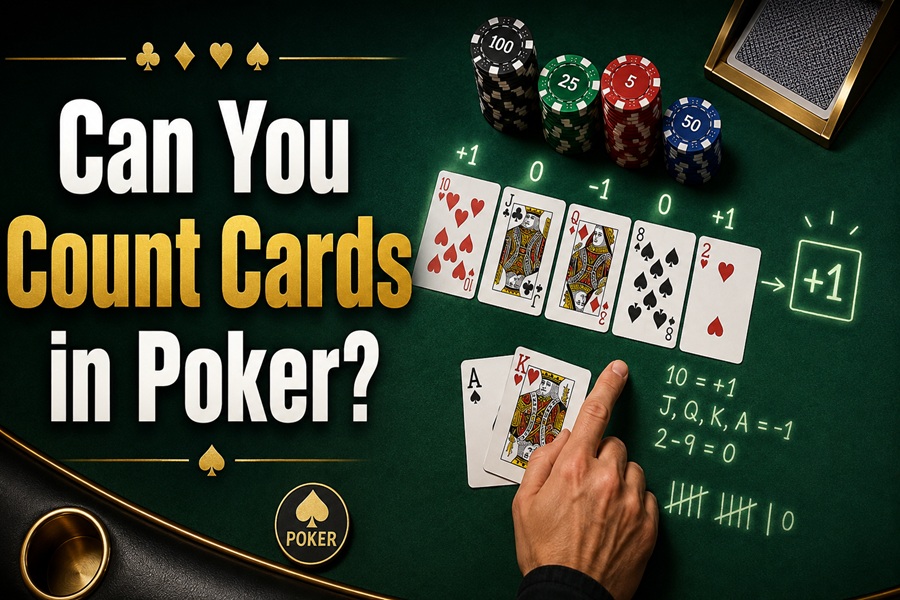
  • Can You Count Cards in Poker? Yes, but Not the Way You Think

    Can You Count Cards in Poker? Yes, but Not the Way You Think

    You can count cards in poker, and it is completely legal. But it works nothing like blackjack. In blackjack you track a running count to beat the house. In poker you count outs, use blockers, and calculate equity to beat other players. Same idea, tracking cards to gain information, but a totally different toolkit. Here is what actually works, and what is a myth.

    Is counting cards in poker the same as blackjack?

    No. And this is where most people get confused, so let us clear it up first.

    Blackjack card counting relies on two things poker does not offer:

    • The deck is not reshuffled every hand. In blackjack, cards dealt in one round affect the odds of the next.
    • You play against the house. A high count means you bet more against a fixed dealer.

    Poker breaks both. The deck is shuffled fully after every hand, so past cards tell you nothing about the next deal. And you play against other people, not a house with fixed rules. A “count” in the blackjack sense gives you zero edge in poker.

    So classic card counting does not transfer. But a different, legitimate form of card counting is not just possible in poker, it is essential.

    So what does “counting cards” mean in poker?

    In poker, counting cards means using the cards you can see, your hole cards and the community cards, to work out what your opponent can and cannot have. It happens within a single hand, not across hands.

    It shows up under three names:

    1. Counting outs (which cards improve your hand).
    2. Using blockers (cards you hold that your opponent cannot).
    3. Calculating equity (your percentage chance to win).

    Each of these is card counting, just applied to incomplete information instead of a running deck total. Let us take them one at a time.

    How do you count outs in poker?

    An out is any card left in the deck that improves your hand to a likely winner.

    Say you hold two hearts and two more hearts hit the board. You are one heart away from a flush. There are 13 hearts in a deck, you can see 4 of them, so 9 hearts remain. You have 9 outs.

    Counting outs is the foundation of poker math. Once you know your outs, you can estimate your chance of hitting.

    Common out counts to memorize:

    Draw Outs
    Flush draw 9
    Open-ended straight draw 8
    Gutshot (inside) straight draw 4
    Two overcards 6
    Flush draw + open-ended straight 15

    What is the Rule of 2 and 4?

    This is the shortcut that turns outs into a percentage in your head. It is the single most useful piece of poker card counting.

    The rule:

    • On the flop (two cards still to come): multiply your outs by 4 to estimate your chance of hitting by the river.
    • On the turn (one card to come): multiply your outs by 2 to estimate your chance of hitting on the river.

    Example with a 9-out flush draw:

    • On the flop: 9 x 4 = roughly 36% to make the flush by the river.
    • On the turn: 9 x 2 = roughly 18% to make it on the river.

    It is not perfectly exact. The true flop number is closer to 35% and the turn closer to 19.5%. But it is close enough to make correct decisions fast, which is the entire point during a live hand.

    What are blockers, and why do they matter?

    Blockers are the sneakiest form of card counting in poker, and most casual players never use them.

    A blocker is a card in your hand that your opponent cannot have, because you are holding it. It shrinks the range of hands they can hold.

    Here is a clean example. You hold the Ace of hearts. The board shows three hearts. Can your opponent have the nut flush (Ace-high flush)? No. You hold the Ace of hearts, so it is impossible. You block the best possible flush.

    That knowledge changes everything. It means:

    • You can bluff more confidently, because they cannot hold the hand that beats you.
    • You can fold more confidently, because you know exactly which strong hands are off the table.

    Blockers are pure card counting. You are counting a specific card, the one in your hand, to eliminate an opponent’s holdings.

    In which poker games does card counting matter most?

    Not all poker variants offer the same information. Here is where card counting pays off most.

    • Texas Hold’em: Counting outs and blockers on the community cards. The everyday application.
    • Pot-Limit Omaha: Four hole cards mean more blockers and trickier out counts. Holding extra cards of a suit reduces your own flush outs.
    • Seven Card Stud: The big one. Many cards are dealt face-up, so tracking exposed cards is essential. If the cards you need are already showing in opponents’ hands, your draw is dead. Skilled Stud players count folded and visible cards on every street.

    In Stud especially, ignoring the exposed cards while your opponents track them puts you at a serious, ongoing disadvantage.

    Is counting cards in poker legal?

    Yes. Fully legal, and not even controversial.

    Poker is a skill game played against other players, not the house. Using the visible cards to make better decisions is simply good play. No casino will ever remove you for counting outs or using blockers. It is expected.

    Contrast that with blackjack, where counting is legal but casinos actively discourage it and may bar skilled counters. In poker, card counting is baked into the game. Every winning player does it.

    What do experienced players say about it?

    Forum consensus is sharp on this topic, and it debunks a common myth.

    On poker subreddits, TwoPlusTwo, and coaching sites, experienced players stress one warning above all: you cannot predict future deals by counting past hands. Because the deck reshuffles every hand, talk of a card being “hot” or “cold,” the way people describe roulette, is nonsense. Regulars call this out constantly. The odds reset completely every single shuffle.

    The other repeated point is that real poker card counting is about the current hand only. Threads on Quora and Upswing-style coaching content frame it the same way: counting outs and using blockers within the hand is the legitimate skill. Anything claiming to forecast the next flop from previous flops is a beginner trap.

    Unique insight: poker counting is subtraction, not addition

    Here is a framing that clarifies the whole topic. Blackjack counting is addition. You keep a running total that grows across many hands.

    Poker counting is subtraction. You start with all the cards an opponent could have, then subtract everything that is impossible: the cards in your hand, the cards on the board, and the draws that are already dead. What remains is their real range.

    That mental switch matters. Beginners try to “count the deck” in poker and fail, because there is nothing to accumulate. Strong players instead ask, on every street, “what has been removed from what my opponent can have?” Blockers remove hands. Community cards remove draws. Your own cards remove combinations. Poker card counting is the discipline of shrinking your opponent’s range one impossible hand at a time.

    Frequently asked questions

    Can you count cards in poker like in blackjack?

    No. Blackjack counting works across hands because the deck is not reshuffled. Poker reshuffles every hand, so counting in poker means counting outs, blockers, and equity within a single hand.

    Is counting cards in poker illegal?

    No. It is legal and expected. Poker is a skill game against other players, so using visible cards to make decisions is just good play. No casino bans it.

    What is the Rule of 2 and 4 in poker?

    Multiply your outs by 4 on the flop, or by 2 on the turn, to estimate your chance of hitting by the river. A 9-out flush draw is about 36% on the flop and 18% on the turn.

    What are blockers in poker?

    Cards you hold that your opponent cannot have. Holding the Ace of a suit blocks them from making the top flush in that suit, which helps you bluff and fold more accurately.

    Does counting cards help in Texas Hold’em?

    Yes, through counting outs and using blockers. You cannot predict future hands, but you can read your opponent’s range within the current hand.

    Can you predict the next hand by counting cards in poker?

    No. The deck is fully shuffled between hands, so past cards have no effect on future deals. Claims of “hot” or “cold” cards across hands are a myth.

  • Can You Play Poker With Two People? Yes, and It Is Called Heads-Up

    Can You Play Poker With Two People? Yes, and It Is Called Heads-Up

    Short answer: yes, you can absolutely play poker with two people. Two-player poker has a name, heads-up, and it is one of the purest and most demanding forms of the game. The rules are almost identical to a full table, with one twist that confuses nearly every beginner: the blinds and the button work backward. Get that one piece right and you are ready to deal.

    Let us walk through it, hand by hand.

    Can poker be played with only two players?

    Yes. Any poker variant works with two people. Texas Hold’em, Omaha, Seven Card Stud, Five Card Draw, all of it plays heads-up.

    You will run into heads-up poker in three common situations:

    • A cash game between two people. More common online than in live rooms.
    • A heads-up tournament, where players face off one-on-one in a bracket until one winner remains.
    • The final stage of any tournament, when everyone else has busted and two players fight for first.

    So heads-up is not a niche side game. It is the finish line of almost every tournament ever played, which is why serious players train for it.

    What is heads-up poker?

    Heads-up poker simply means a hand or a game contested by exactly two players. Nothing more.

    The betting actions are the same ones you already know: check, bet, call, raise, and fold. The hand rankings do not change. A flush still beats a straight.

    What changes is the math and the mindset. With only two players, you cannot wait for premium hands. You are in the blind on every single deal, so folding your way to profit is impossible. Heads-up rewards aggression, position, and reading one specific opponent closely.

    How do the blinds work in two-player poker?

    This is the part that trips people up, so read it slowly.

    In heads-up poker, the player on the button posts the small blind. The other player posts the big blind. That is the reverse of what many people expect.

    Here is the setup for each hand:

    • The button (dealer) posts the small blind.
    • The non-button player posts the big blind.
    • Players alternate the button every hand, so the blinds even out over time.

    Because someone posts a blind on every deal, there is always money in the middle. The action never stalls the way it can at a crowded table.

    Who acts first in heads-up poker?

    Another reversal, and this one matters for strategy.

    Before the flop: the button (small blind) acts first. The button can fold, call, or raise. The big blind acts last pre-flop.

    After the flop (flop, turn, and river): the order flips. The big blind acts first, and the button acts last.

    That post-flop last-action advantage is huge. The button sees what the opponent does on every street before deciding, which is why the button seat is so powerful heads-up.

    Quick reference:

    Street Acts first Acts last
    Pre-flop Button (small blind) Big blind
    Flop, turn, river Big blind Button

    How do you deal a two-player hand step by step?

    Here is a full Texas Hold’em hand between two players, start to finish.

    1. Decide who starts on the button. Both players post their blinds (button posts small, opponent posts big).
    2. Deal two hole cards to each player, one at a time. The first card goes to the big blind, then the button.
    3. Pre-flop betting. The button acts first.
    4. Deal the flop (three community cards). Big blind acts first now.
    5. Flop betting.
    6. Deal the turn (fourth community card).
    7. Turn betting.
    8. Deal the river (fifth community card).
    9. River betting.
    10. Showdown, if both players remain. Best five-card hand wins.
    11. Pass the button to the other player and repeat.

    That is the whole loop. The only oddity is the reversed blinds and action order. Everything else is standard poker.

    Does every poker variant work with two players?

    Yes, though a few adjust slightly.

    • Texas Hold’em: The most popular heads-up game. Rules exactly as above.
    • Pot-Limit Omaha: Same structure, but each player gets four hole cards and must use exactly two at showdown.
    • Five Card Draw: Both players ante, get five cards, bet, discard and draw, bet again, then show down.
    • Seven Card Stud: No community cards. Players bring in and bet across multiple streets. Works fine with two.

    One practical tip from home-game players: use one deck to deal while the other player shuffles the second deck. It keeps the game moving between hands.

    What do players say about heads-up on forums?

    Community advice on this is remarkably consistent.

    On poker subreddits and forums like TwoPlusTwo, the loudest theme is that heads-up punishes passive play. Between two equally skilled players, the more aggressive one wins more sessions over time. Regulars also stress that hand values shift hard: a hand like King-high or a small pair, marginal at a full table, becomes strong when only one opponent can beat it.

    Another repeated point from beginners on Quora and community threads: the worst starting hand changes heads-up. At a full ring, players often name 7-2 offsuit. Heads-up, with far fewer hands to run into, the ranking of “trash” shifts, and almost every two-card hand is playable in the right spot.

    The consensus is simple. Heads-up is where you learn to actually play poker, because you cannot hide behind position or wait for aces.

    Unique insight: heads-up is a blind-defense game, not a big-hand game

    Most guides frame heads-up as “play more aggressively.” True, but here is the deeper reason nobody spells out.

    At a nine-handed table, you post a blind roughly once every nine hands. Heads-up, you post a blind every single hand. Do nothing and you bleed chips continuously.

    That single fact rewrites the whole game. You are not waiting for strong hands. You are constantly deciding whether this hand is worth more than the blind you are being forced to defend. Aggression heads-up is not recklessness. It is the correct response to paying a toll on every deal. Once you see heads-up as continuous blind defense rather than a hunt for monsters, the aggressive style stops feeling risky and starts feeling obvious.

    Frequently asked questions

    Can two people play Texas Hold’em?

    Yes. Two-player Texas Hold’em is called heads-up. The rules match a full table except the button posts the small blind and acts first pre-flop, then last after the flop.

    Who posts the small blind in heads-up poker?

    The player on the button posts the small blind. The other player posts the big blind. This is the reverse of a full-ring game.

    Who deals first with two players?

    The first card goes to the big blind, then the button, matching the normal clockwise dealing pattern.

    Is heads-up harder than regular poker?

    It is more demanding. You play every hand, you cannot fold your way to profit, and reading one opponent well becomes the whole game. Many players consider it the truest test of skill.

    What is the best starting hand heads-up?

    Pocket aces, same as always. But the value of medium and weak hands rises sharply because only one opponent can beat you, so many more hands become playable.

    Can you play other poker games with two people?

    Yes. Omaha, Seven Card Stud, and Five Card Draw all work heads-up. Only the deal and betting structure of each variant applies, played between two players.