
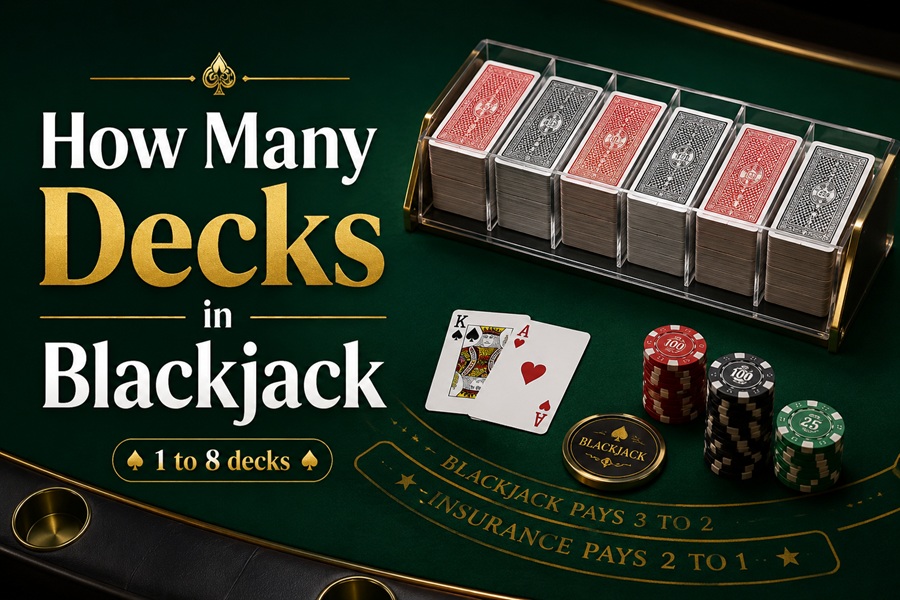
Tag: 8-deck blackjack game

  • How Many Decks in Blackjack? Deck Counts, Odds, and the One Rule That Beats Them All

    How Many Decks in Blackjack? Deck Counts, Odds, and the One Rule That Beats Them All

    Quick answer: Blackjack is played with anywhere from 1 to 8 decks. Single-deck uses 52 cards. Most modern casino tables use 6 decks (312 cards) or 8 decks (416 cards). Fewer decks lower the house edge slightly, but the blackjack payout (3:2 vs 6:5) affects your odds far more than deck count does.

    If you have ever sat at a table and wondered how many decks the dealer is shuffling, you are asking the right question. Deck count shapes your odds, your strategy, and how hard the game is to beat. But there is a twist most guides skip, and it can quietly cost you money. We will get to it.

    How many decks are used in blackjack?

    The short version: 1 to 8 decks. The long version depends on where you play and which table you pick.

    Here are the standard formats you will run into:

    • Single-deck: 1 deck, 52 cards.
    • Double-deck: 2 decks, 104 cards.
    • Four-deck: 4 decks, 208 cards.
    • Six-deck: 6 decks, 312 cards. The most common shoe on the floor.
    • Eight-deck: 8 decks, 416 cards. Common in high-traffic and online live-dealer games.

    Six and eight decks dominate today. Single and double-deck games still exist, but they are rarer, and they often come with catches we will cover below.

    Why do casinos use more than one deck?

    Blackjack started as a single-deck game. Then card counting arrived, and everything changed.

    With one deck, a sharp player can track which cards have been dealt and shift bets when the odds tilt in their favor. Casinos responded by shuffling more decks together. The more cards in play, the smaller the effect of any single card leaving the shoe, and the weaker a counter’s edge becomes.

    Multi-deck play does more than blunt counters. It speeds up the game. A single-deck table needs a shuffle after almost every round. A six-deck shoe runs for many hands before the dealer reshuffles, which means more hands per hour for the house.

    Some tables skip the shoe entirely and use a continuous shuffling machine (CSM). A CSM feeds played cards back into the mix constantly, so the count never builds. Counters avoid these tables, but casual players barely notice the difference.

    Does the number of decks change the house edge?

    Yes, but less than most people assume. Fewer decks help the player. Here is roughly how the base house edge moves as decks are added, assuming otherwise identical rules and a 3:2 payout.

    Deck count Cards in play Approx. house edge (basic strategy, 3:2) Natural blackjack odds
    Single deck 52 0.15% to 0.30% ~4.83%
    Double deck 104 ~0.35% to 0.45% ~4.78%
    Four deck 208 ~0.45% ~4.76%
    Six deck 312 0.45% to 0.60% ~4.75%
    Eight deck 416 0.50% to 0.65% ~4.75%

    Two things drive the single-deck advantage:

    1. You hit a natural blackjack more often. With fewer cards, the ace-and-ten combo lands slightly more frequently.
    2. The dealer copies your blackjack less often. Pushes are more common in six and eight-deck games, and a push earns you nothing on a hand that should pay 3:2.

    So single-deck wins on paper. But paper is not the whole story.

    What matters more than deck count? The 6:5 payout trap

    This is the part most articles bury or skip. Read it twice.

    A natural blackjack should pay 3:2. Bet 10, win 15. Many single-deck and short-deck tables quietly pay 6:5 instead. Bet 10, win only 12.

    That one change adds roughly 1.39% to the house edge. It swamps every advantage you gained from playing fewer decks. A single-deck 6:5 game is worse for you than the worst 8-deck 3:2 game on the floor.

    Put simply:

    • A single-deck game at 3:2 is excellent.
    • A single-deck game at 6:5 is a trap dressed up as a bargain.
    • A six-deck game at 3:2 beats a single-deck game at 6:5 every time.

    The rule that beats them all: check the payout first, deck count second. If the felt says 6:5, walk away, no matter how few decks are in the shoe.

    What do experienced players say about deck count?

    Regulars on blackjack forums are blunt about this. On the Wizard of Odds community and blackjack subreddits, the most repeated advice is not “find single-deck.” It is “never play 6:5.” Players on Las Vegas travel forums warn newcomers that the low-limit single-deck tables downtown and on the Strip almost always carry the 6:5 short pay, which cancels the deck advantage.

    A common thread on Quora captures the shift bluntly: decades ago single and double-deck games were everywhere, and now they are scarce, because the house learned that fewer decks favored skilled players. The community consensus lands in the same place: rules beat deck count.

    That real-world sentiment matters. The math says single-deck is best. The players who actually grind these tables say the payout and side rules decide the game, and they are right.

    How do the rules interact with deck count?

    Deck count never travels alone. Casinos pair deck configurations with rule tweaks, and the rules can matter as much as the cards.

    Watch for these when you sit down:

    • Payout: 3:2 good, 6:5 bad. Non-negotiable.
    • Soft 17: Dealer standing on soft 17 (S17) is better for you than the dealer hitting it (H17).
    • Double after split (DAS): Allowed is better.
    • Surrender: Late surrender available is a small bonus in your favor.
    • Re-splitting and doubling limits: More freedom favors you.

    A six-deck game with 3:2 payouts, S17, DAS, and surrender can beat a single-deck game loaded with restrictive rules. Always read the full table, not just the deck count.

    Unique insight: deck count is a shortcut, not the answer

    Here is a framing you will not find on most top pages. Deck count is a proxy, not a verdict.

    Newer players treat “how many decks” as the one question that settles which table is best. It is really just one input among five or six. The pros do not ask “how many decks” first. They scan the felt in a fixed order: payout, then soft 17, then double and split rules, then surrender, and only then deck count.

    If you memorize that order, you will outperform players who chase single-deck tables blindly and get quietly clipped by a 6:5 short pay. Deck count is where beginners start and where experts finish.

    Frequently asked questions

    How many decks are in a shoe at most casinos?

    Six is the most common, followed by eight. Single and double-deck games exist but are less common and often carry weaker payout rules.

    How many cards are in an 8-deck blackjack game?

    416 cards. Each standard deck holds 52 cards, and eight of them shuffled together make 416.

    Is single-deck blackjack better than 6-deck?

    Only if both pay 3:2. A single-deck game at 6:5 is worse than a 6-deck game at 3:2. Check the payout before the deck count.

    Does deck count affect basic strategy?

    Barely. A few close decisions on doubles, splits, and surrender shift slightly, but the core strategy chart works across deck counts. The bigger changes come from the soft 17 rule.

    Why do casinos use so many decks?

    To slow down card counters and to speed up play. More decks mean fewer shuffles, more hands per hour, and a smaller edge for anyone tracking cards.

    What is a continuous shuffling machine?

    A CSM reshuffles played cards back into the game constantly. It removes any chance to count and keeps the game moving, which is why counters avoid those tables.