
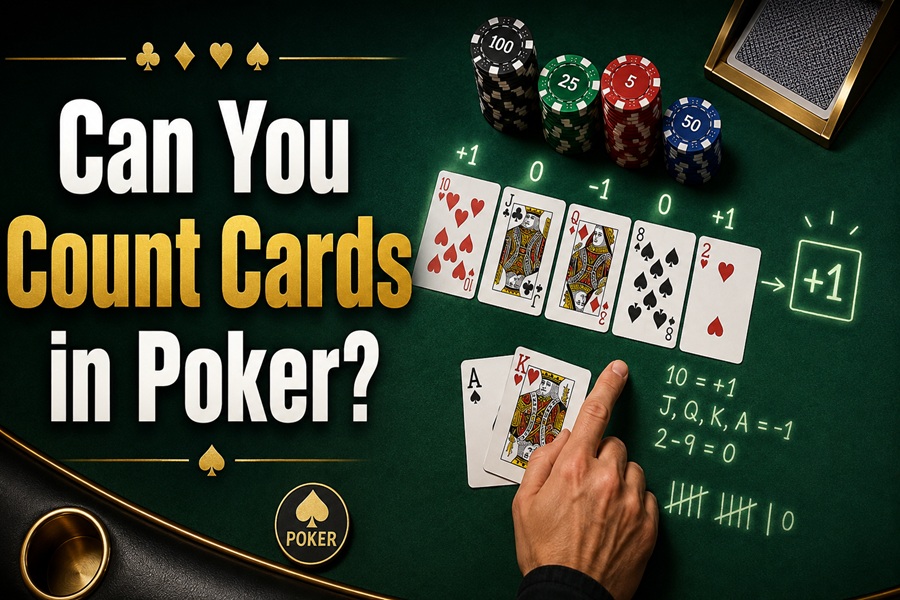
You can count cards in poker, and it is completely legal. But it works nothing like blackjack. In blackjack you track a running count to beat the house. In poker you count outs, use blockers, and calculate equity to beat other players. Same idea, tracking cards to gain information, but a totally different toolkit. Here is what actually works, and what is a myth.
Is counting cards in poker the same as blackjack?
No. And this is where most people get confused, so let us clear it up first.
Blackjack card counting relies on two things poker does not offer:
- The deck is not reshuffled every hand. In blackjack, cards dealt in one round affect the odds of the next.
- You play against the house. A high count means you bet more against a fixed dealer.
Poker breaks both. The deck is shuffled fully after every hand, so past cards tell you nothing about the next deal. And you play against other people, not a house with fixed rules. A “count” in the blackjack sense gives you zero edge in poker.
So classic card counting does not transfer. But a different, legitimate form of card counting is not just possible in poker, it is essential.
So what does “counting cards” mean in poker?
In poker, counting cards means using the cards you can see, your hole cards and the community cards, to work out what your opponent can and cannot have. It happens within a single hand, not across hands.
It shows up under three names:
- Counting outs (which cards improve your hand).
- Using blockers (cards you hold that your opponent cannot).
- Calculating equity (your percentage chance to win).
Each of these is card counting, just applied to incomplete information instead of a running deck total. Let us take them one at a time.
How do you count outs in poker?
An out is any card left in the deck that improves your hand to a likely winner.
Say you hold two hearts and two more hearts hit the board. You are one heart away from a flush. There are 13 hearts in a deck, you can see 4 of them, so 9 hearts remain. You have 9 outs.
Counting outs is the foundation of poker math. Once you know your outs, you can estimate your chance of hitting.
Common out counts to memorize:
| Draw | Outs |
|---|---|
| Flush draw | 9 |
| Open-ended straight draw | 8 |
| Gutshot (inside) straight draw | 4 |
| Two overcards | 6 |
| Flush draw + open-ended straight | 15 |
What is the Rule of 2 and 4?
This is the shortcut that turns outs into a percentage in your head. It is the single most useful piece of poker card counting.
The rule:
- On the flop (two cards still to come): multiply your outs by 4 to estimate your chance of hitting by the river.
- On the turn (one card to come): multiply your outs by 2 to estimate your chance of hitting on the river.
Example with a 9-out flush draw:
- On the flop: 9 x 4 = roughly 36% to make the flush by the river.
- On the turn: 9 x 2 = roughly 18% to make it on the river.
It is not perfectly exact. The true flop number is closer to 35% and the turn closer to 19.5%. But it is close enough to make correct decisions fast, which is the entire point during a live hand.
What are blockers, and why do they matter?
Blockers are the sneakiest form of card counting in poker, and most casual players never use them.
A blocker is a card in your hand that your opponent cannot have, because you are holding it. It shrinks the range of hands they can hold.
Here is a clean example. You hold the Ace of hearts. The board shows three hearts. Can your opponent have the nut flush (Ace-high flush)? No. You hold the Ace of hearts, so it is impossible. You block the best possible flush.
That knowledge changes everything. It means:
- You can bluff more confidently, because they cannot hold the hand that beats you.
- You can fold more confidently, because you know exactly which strong hands are off the table.
Blockers are pure card counting. You are counting a specific card, the one in your hand, to eliminate an opponent’s holdings.
In which poker games does card counting matter most?
Not all poker variants offer the same information. Here is where card counting pays off most.
- Texas Hold’em: Counting outs and blockers on the community cards. The everyday application.
- Pot-Limit Omaha: Four hole cards mean more blockers and trickier out counts. Holding extra cards of a suit reduces your own flush outs.
- Seven Card Stud: The big one. Many cards are dealt face-up, so tracking exposed cards is essential. If the cards you need are already showing in opponents’ hands, your draw is dead. Skilled Stud players count folded and visible cards on every street.
In Stud especially, ignoring the exposed cards while your opponents track them puts you at a serious, ongoing disadvantage.
Is counting cards in poker legal?
Yes. Fully legal, and not even controversial.
Poker is a skill game played against other players, not the house. Using the visible cards to make better decisions is simply good play. No casino will ever remove you for counting outs or using blockers. It is expected.
Contrast that with blackjack, where counting is legal but casinos actively discourage it and may bar skilled counters. In poker, card counting is baked into the game. Every winning player does it.
What do experienced players say about it?
Forum consensus is sharp on this topic, and it debunks a common myth.
On poker subreddits, TwoPlusTwo, and coaching sites, experienced players stress one warning above all: you cannot predict future deals by counting past hands. Because the deck reshuffles every hand, talk of a card being “hot” or “cold,” the way people describe roulette, is nonsense. Regulars call this out constantly. The odds reset completely every single shuffle.
The other repeated point is that real poker card counting is about the current hand only. Threads on Quora and Upswing-style coaching content frame it the same way: counting outs and using blockers within the hand is the legitimate skill. Anything claiming to forecast the next flop from previous flops is a beginner trap.
Unique insight: poker counting is subtraction, not addition
Here is a framing that clarifies the whole topic. Blackjack counting is addition. You keep a running total that grows across many hands.
Poker counting is subtraction. You start with all the cards an opponent could have, then subtract everything that is impossible: the cards in your hand, the cards on the board, and the draws that are already dead. What remains is their real range.
That mental switch matters. Beginners try to “count the deck” in poker and fail, because there is nothing to accumulate. Strong players instead ask, on every street, “what has been removed from what my opponent can have?” Blockers remove hands. Community cards remove draws. Your own cards remove combinations. Poker card counting is the discipline of shrinking your opponent’s range one impossible hand at a time.
Frequently asked questions
Can you count cards in poker like in blackjack?
No. Blackjack counting works across hands because the deck is not reshuffled. Poker reshuffles every hand, so counting in poker means counting outs, blockers, and equity within a single hand.
Is counting cards in poker illegal?
No. It is legal and expected. Poker is a skill game against other players, so using visible cards to make decisions is just good play. No casino bans it.
What is the Rule of 2 and 4 in poker?
Multiply your outs by 4 on the flop, or by 2 on the turn, to estimate your chance of hitting by the river. A 9-out flush draw is about 36% on the flop and 18% on the turn.
What are blockers in poker?
Cards you hold that your opponent cannot have. Holding the Ace of a suit blocks them from making the top flush in that suit, which helps you bluff and fold more accurately.
Does counting cards help in Texas Hold’em?
Yes, through counting outs and using blockers. You cannot predict future hands, but you can read your opponent’s range within the current hand.
Can you predict the next hand by counting cards in poker?
No. The deck is fully shuffled between hands, so past cards have no effect on future deals. Claims of “hot” or “cold” cards across hands are a myth.
